She writes

Othello: The Death of Innocents
The Death of Innocents: Why Women Pay for Men’s Tragic Flaws in Shakespeare
What is so unbearable about Othello is that Othello’s tragic flaw does not simply destroy Othello. Iago’s malice does not simply consume Iago. Their failures radiate outward, and the people who pay the greatest price are Desdemona and Emilia — women whose moral development is, perversely, greater than that of the men whose tragedy supposedly structures the play.
It raises an uncomfortable question about Shakespearean tragedy:
Why does the tragic protagonist so often discover the truth about himself only after people who did nothing to deserve his fate have been destroyed by it?

Hamlet: “O Cursed Spite…”
In William Shakespeare's Hamlet, the conclusion of Act 1 leaves Prince Hamlet burdened with the impossible task of avenging his father's murder. Confronted by the Ghost's command to "Remember me" and "Revenge his foul and most unnatural murder," Hamlet laments, "The time is out of joint. O cursed spite, / That ever I was born to set it right." The language is striking. Hamlet does not embrace his duty as an honour or a privilege; he experiences it as a curse. His father's final request becomes a paternal legacy that binds him to a future of violence, moral uncertainty and inevitable tragedy.

Twelfth Night: “I’ll be revenged on the whole pack of you”
Comedy is often associated with celebration. Weddings, music, laughter, and reconciliation typically signal the restoration of social harmony. William Shakespeare's, Twelfth Night, appears to offer precisely this kind of festive world. Set against a backdrop of revelry, disguise, mistaken identity, and romantic pursuit, the play delights in disorder and entertainment. Yet beneath this atmosphere of celebration lies a more unsettling question. While some characters find love, belonging, and happiness, Malvolio becomes the target of an increasingly cruel deception that culminates in public humiliation and psychological torment. Shakespeare therefore challenges audiences to consider whether laughter and entertainment can become something darker, asking us to question where the line between comedy and cruelty lies.

Othello: “Give me the Ocular Proof”
Before it becomes “ocular proof,” and the catalyst for jealousy and murder, the handkerchief in William Shakespeare’s play, Othello, begins as an object of love.
In a society where physical intimacy was heavily restricted, small objects often carried immense emotional significance. Handkerchiefs, letters, and tokens of affection became substitutes for touchitself. They were tangible expressions of intimacy, trust, and devotion. For Shakespeare’s character, Desdemona, this fragile symbol of love becomes the instrument of her destruction.
Shakespeare suggests that once love becomes dependent upon external “proof,” intimacy itself becomes vulnerable to manipulation. Othello no longer trusts what he knows of Desdemona’s character, but what he believes he can see.


The Witches: Fair is foul and foul is Fair
The opening chant of the Witches illustrates their ambiguous role. They do not deceive through direct falsehood. Instead, they equivocate, collapsing opposites into one another so that truth becomes indistinguishable from illusion. Their language resists fixed meaning, creating a reality in which certainty is impossible.
In doing so, Shakespeare positions deception not as an external force imposed on characters, but as a condition of the world itself - one which must be navigated, interpreted and, ultimately, is disastrously misread.

Macbeth: False Face Must Hide
Shakespeare reveals that deception evolves from a performative strategy into a psychological necessity, as Macbeth’s outward appearance must now conceal not just intention, but a fundamentally corrupted inner self.
Where Donalbain warns that there are “daggers in men’s smiles,” and Lady Macbeth instructs Macbeth to “look like the innocent flower,” deception initially exists as an external strategy. However, as the play progresses, Macbeth no longer simply performs deception, instead, he becomes defined by it.
For Macbeth, deception evolves into something far more dangerous. For him, it is something that is internalised.

Lady Macbeth: Look the Innocent Flower
Lady Macbeth’s instruction to “look like the innocent flower, but be the serpent under’t” reflects a different reality for women, as she recognises that power cannot be exercised through physical force, but must instead be achieved through performance. Deception, therefore, becomes a strategic tool of agency, allowing her to exert influence within a system that denies her overt authority.

Othello: Trifles Light as Air
William Shakespeare’s, Othello, explores the destructive capability of the imagination and how, once poisoned by envy and suspicion, it can misshape perception and destabilise truth. Critical attention often centres on Othello’s jealousy, yet it is Iago’s envy that truly sets the tragedy in motion. Personally, I think it is worthwhile, then, to distinguish between these two emotions to students, for Iago embodies both, while Othello experiences only one - and that is manufactured by Iago himself.

Othello: Men Should Be what They Seem
In Othello, power is not seized through force, but through language. Iago does not command; instead, he suggests, questions, and implies, using words to reshape reality itself. Understanding how Shakespeare constructs the language of manipulation is essential not only for analysing the play, but for writing high-level essays.

Macbeth & Madness: Avaunt and Quit my Sight!
Avaunt and quit my sight! Let the earth hide thee!
William Shakespeare’s play, Macbeth, is a profound exploration of guilt and the conscience.

Less is More
In classrooms crammed with content and competing demands, it’s easy to fall into the trap of teaching more, faster. But true learning doesn’t come from overload, it comes from focus. By reducing extraneous cognitive load and delivering spear-headed outcomes, we create the conditions for deep learning, an environment where students respond with depth, nuance, and ownership, and in an increasingly “standardised” world, this approach nurtures something rare: individual thought.

Macbeth: She Should Have Died Hereafter
Macbeth: Murderer, tyrant, widower. Humanising the tyrant by understanding the significance of the line, "She should have died hereafter".

Act Like a Lady
Act like a lady - representations of femininity in William Shakespeares’s play, “Macbeth”.
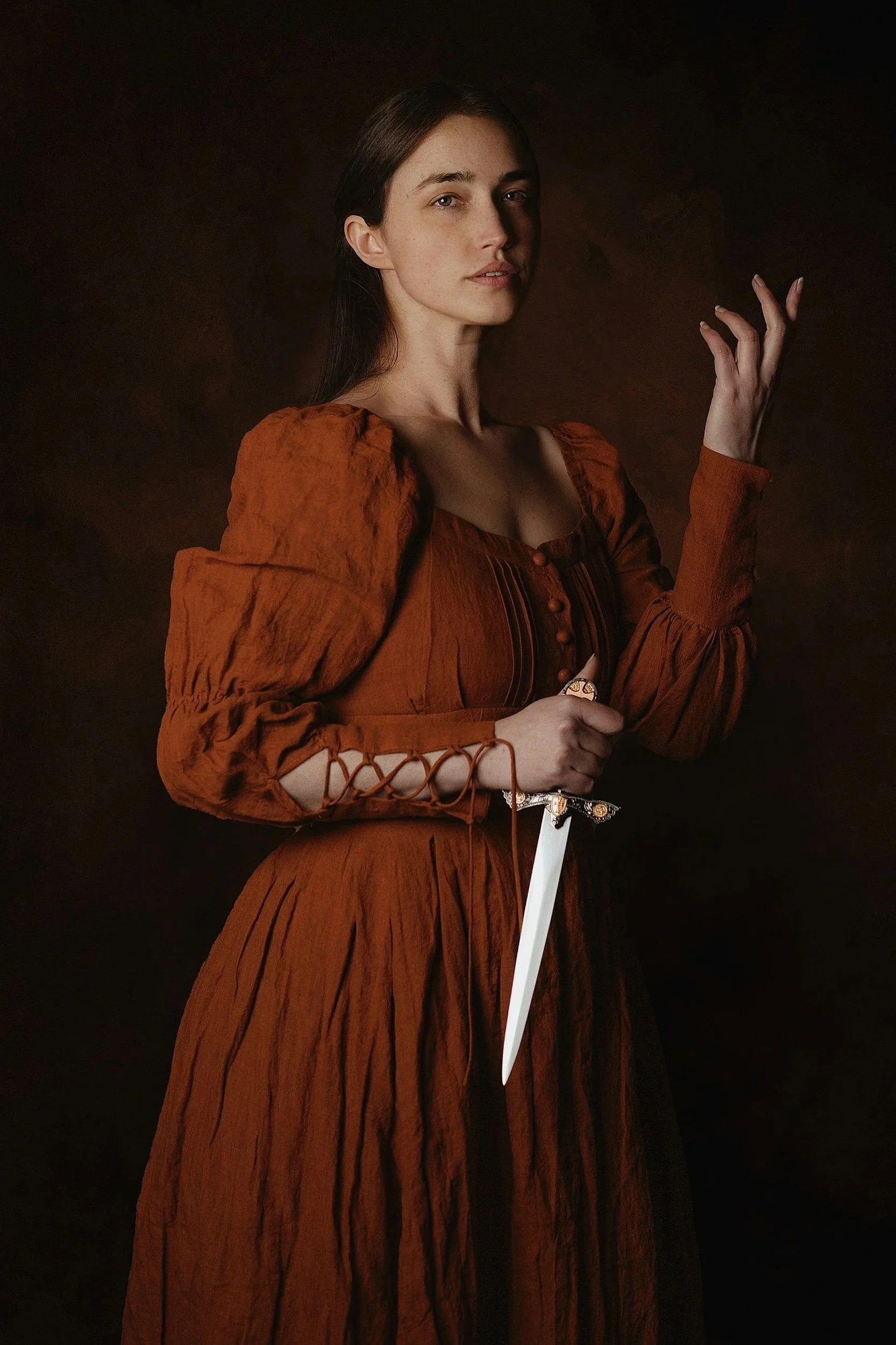
Macbeth: Daggers in Men’s Smiles
Donalbain's brief appearance delivers one of the most memorable lines: "Where we are, there are daggers in men's smiles." This line is not only significant for its immediate dramatic context, but also for its broader implications within the play. It distils the theme of appearance versus reality into a potent metaphor and offers thought provoking insight on the treacherous nature of human interactions, particularly in the cutthroat world of political ambition.

The Tempest & Nature
William Shakespeare’s play, “The Tempest” is a delightful exploration of the natural world and draws upon the contemporary discoveries of the “New World”.

